Ask an equipment engineer why a tool’s data stopped and the first answer is often “it shows connected”. That answer is frequently true and still beside the point, because in HSMS, connected and able to talk are two different states.
This post explains the difference, why a green light that only means “TCP is up” misleads, and what a host should report instead.
Two steps, not one
An HSMS session, SEMI E37, comes up in two steps. First a TCP connection opens. Then the active side, normally the host, sends a Select.req and the tool answers Select.rsp. Only after that second step is the session selected, and only a selected session may carry SECS-II messages.
Between the two steps the link is connected but NOT SELECTED. Nothing useful can flow. A tool that accepts the TCP connection and never answers the select, or rejects it, sits there indefinitely unless a timer ends it: T7, ten seconds by default, is how long a connection may stay not selected before it is dropped.
A status display that turns green when TCP opens will show such a tool as healthy while it delivers nothing.
The four states
| State | What it means | What an operator should read |
|---|---|---|
| Connecting | The host is trying to reach the tool | Not yet; wait or check the network |
| Connected | TCP is up, the session is not selected | Not working yet, despite the word |
| Selected | The session is up; messages can flow | Working |
| Disconnected | The link is down, with a reason | Read the reason |
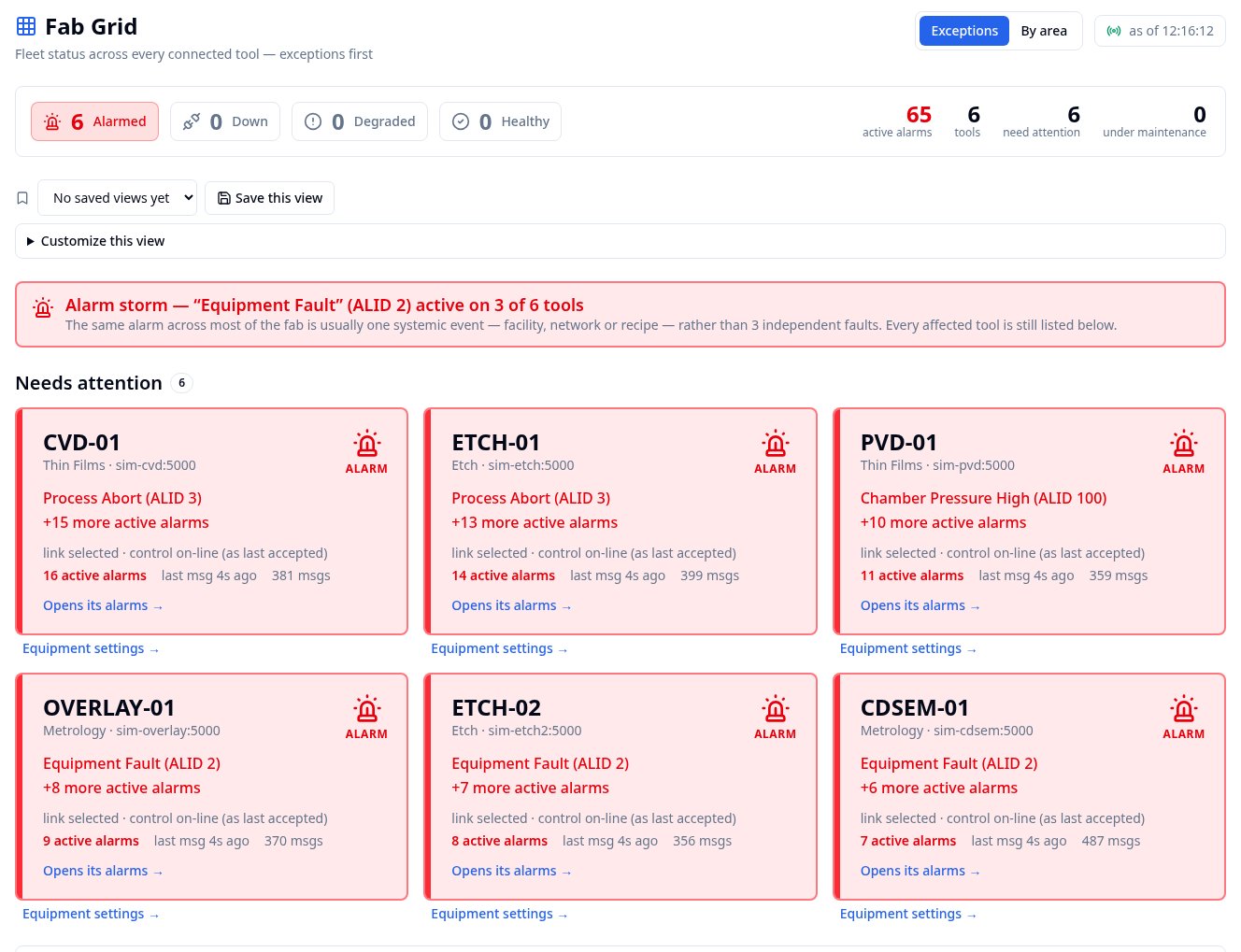
That is why FabConnect’s gateway reports a connected-but-not-selected tool as “connecting” in its live status, and the console shows it in amber as “Connected, not selected”. Only a selected session counts as online.
The reason matters more than the state
“Disconnected” on its own sends someone to the tool with no idea what to look for. The reason narrows it down before anyone walks over:
- The TCP connection failed or timed out. The network, the address, the port, or the tool’s HSMS service is down, or the two ends are set to active and passive the wrong way round. Check reachability first.
- Link closed. The connection ended from the far side: the tool restarted, its HSMS service stopped, or the network dropped it.
- No reply to Select.req within T6. TCP opened but the tool’s HSMS layer is not answering, often because the tool is in the wrong mode or its HSMS service is still starting.
- Select rejected. The tool answered and refused, with the reason it gave: most often it allows one host and another already holds the session.
- T7 not-selected timeout. The connection opened and the session never came up.
- T6 on a linktest, or T8 part-way through a message. A selected link stopped answering, or stalled in the middle of a message. Either way it is treated as dead, dropped and redialled.
- Disconnected on request, or released to a Verify run. Someone did it on purpose.
Reconnecting without flooding
When a link drops, FabConnect waits T5, ten seconds by default, before redialling. While redials fail to connect at all, it doubles the wait each time, up to a minute, and reports a failure only when its reason changes, so a tool that is switched off overnight produces one entry, not hundreds. A redial that does reach the tool reports its progress again, and the wait goes back to T5.
A disconnect requested through the API ends the connection without redialling, so taking a tool down for maintenance does not start a retry loop.
How it reaches the people who need it
The engine publishes each tool’s state as it changes, starting every new subscriber with the current state so nobody has to guess. The gateway records it and pushes each change over WebSocket and the GraphQL subscription, with the reason a link dropped, for anything you build yourself. The console updates each tool’s state without a refresh, and shows why its link last dropped next to it, kept until the tool is selected again.
In a failover pair, only the active gateway writes the recorded state. Without that, a gateway handing over could overwrite the newer “selected” its successor had just written with its own stale view.
The honest boundary
Serial tools work differently. A SECS-I serial line has no select handshake, so for a serial tool FabConnect uses the step GEM defines for both transports: the tool counts as communicating, shown as selected, once it accepts S1F13, Establish Communications. A refusal, no answer, or a failed port shows as disconnected, with the reason.
A linktest is sent every 30 seconds on a selected session, and one left unanswered for T6 drops the link, so a dead link on a quiet network is found within about 35 seconds (the 30-second interval plus T6) rather than whenever the operating system notices.
All of it is covered by automated tests against scripted tools that never select, refuse the select, stop answering linktests, stall part-way through a message or drop the link, and by tests of the redial reporting. It has not yet run against physical equipment.