SECS/GEM in. REST, GraphQL and WebSocket out.
Your tools keep speaking the protocol they shipped with. FabConnect translates it live into the APIs your MES, historians and dashboards already consume — without changing anything on the equipment, or in the systems you already run.
Built on the SEMI equipment-communication standards
Why FabConnect
Transform Your Fab Operations
Built for the equipment-integration problem every fab hits during tool bring-up — and delivered on site, at Indian cost structures
One integration layer, every tool vendor
Standards-based SECS/GEM connectivity instead of a bespoke point-to-point integration per tool. Applies the same way to an etcher, a furnace or a metrology station.
Legacy tools included
Older tools that only speak SECS-I over RS-232 connect alongside modern HSMS equipment — the tools an Ethernet-only platform leaves stranded.
See the floor as it runs
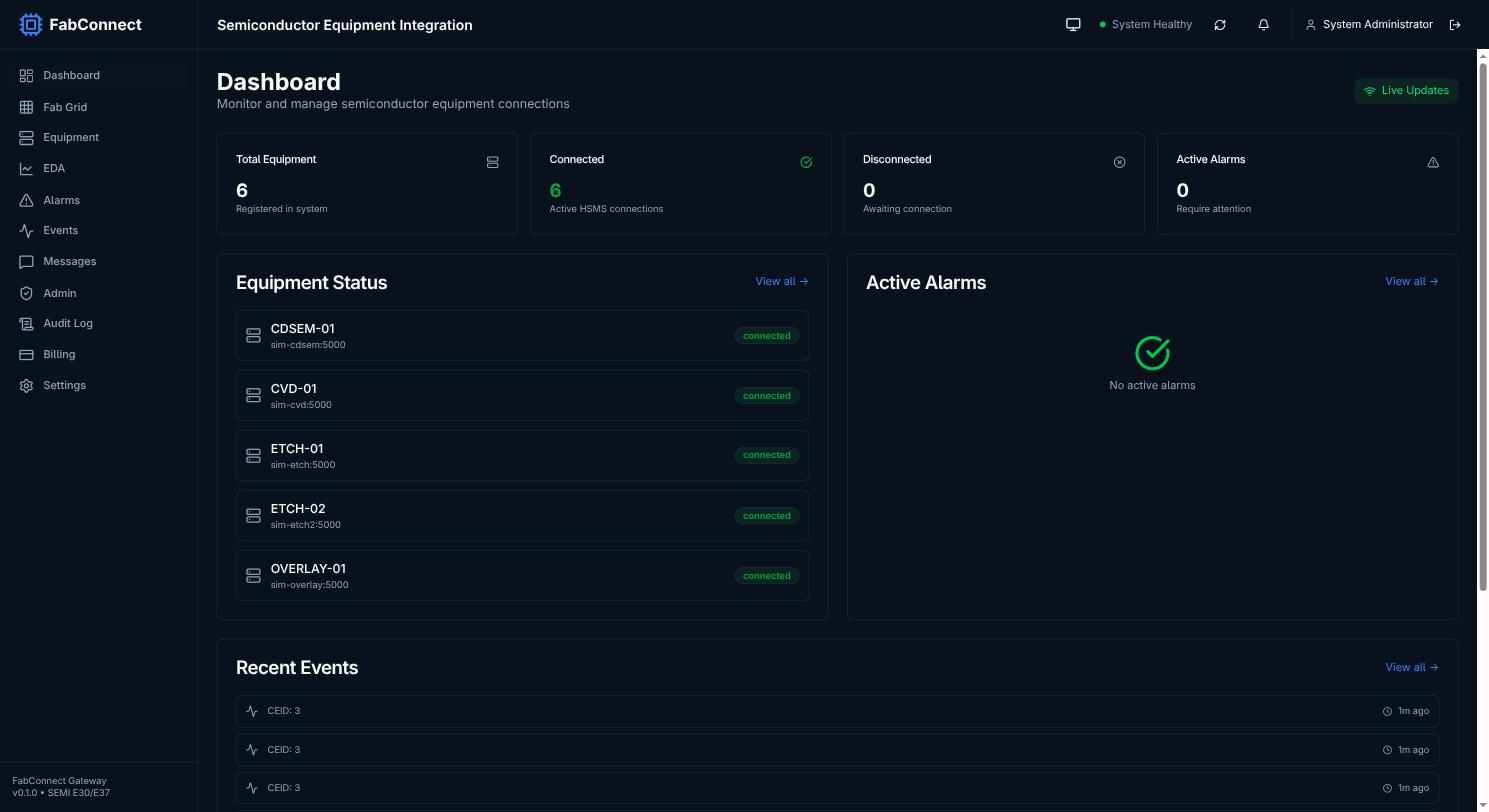
Live equipment state, collection events, alarms and the raw SECS traffic behind them — with every message inspectable down to the wire bytes.
Bring a tool online in hours, not weeks
Standards-based connectivity with reusable equipment profiles is designed to collapse the bespoke integration work that normally dominates a bring-up schedule.
Built to cut integration cost
One platform and one integration pattern across the floor, delivered by an India-based team — aimed at a materially lower total cost than per-tool custom work at foreign day rates.
Engineered for production message rates
A Rust protocol engine with horizontal scaling via Redis pub/sub, built to carry sustained SECS traffic across a full fleet. We benchmark on your equipment rather than quoting a number.
Your data stays where you put it
Deploy fully air-gapped on-premise so equipment telemetry never leaves the fab, or on India-resident cloud when you want cross-site visibility.
An engineering team in the same time zone
Integration delivered on site by an Indian team, at Indian cost structures — not flown in at foreign day rates for each bring-up.
Ready to see how FabConnect can transform your operations?
Everything You Need
Enterprise-Grade Equipment Connectivity
FabConnect provides a complete platform for connecting, monitoring, and controlling your semiconductor manufacturing equipment.
- SECS/GEM Protocol Engine
Native Rust implementation of SEMI E5, E30, E37 standards. High-performance message parsing and state machine management.
- Real-Time Connectivity
HSMS connections with automatic reconnection, heartbeat monitoring and connection pooling — and SECS-I over RS-232 for tools whose only interface is a serial port.
- Enterprise Security
TLS with a 1.2 floor, bcrypt password hashing, TOTP multi-factor, OIDC single sign-on, role-based access control, and an audit trail over equipment, alarm, user and API-key changes.
- Advanced Analytics
Equipment utilisation tracking, alarm analysis and dashboards over live collection-event data, including OEE reporting under SEMI E116.
- High Performance
A Rust protocol engine built for sustained high-volume SECS traffic, with horizontal scaling via Redis pub/sub for distributed deployments. Throughput is benchmarked on your fleet rather than quoted from a datasheet.
- Multi-Site Cloud
Centralized management of multiple fab sites. Data aggregation, cross-site analytics, and unified control.
SEMI Standards
SEMI E-Series Support
The SECS/GEM communication stack and all five GEM300 factory-automation models are implemented and verified end to end against a simulated tool. They have not yet been proven against physical equipment — we say so rather than implying qualification, because you will check.
SECS-II Messages
Complete message format support with all data types
- •Binary, ASCII, JIS-8 encoding
- •List and array structures
- •All format codes (0-67)
GEM Behavior
Full Generic Equipment Model implementation
- •State machine management
- •Variable data collection
- •Alarm management
- •Remote commands
SECS-I Serial
RS-232 connectivity for legacy tools
- •Block framing & checksums
- •ENQ/EOT/ACK handshake
- •Multi-block messages
- •Line contention
HSMS Protocol
High-Speed Message Service over TCP/IP
- •Active & passive modes
- •Separate & single socket
- •Auto-reconnection
- •T3-T8 timers
Process Jobs
Process Job Management for wafer processing
- •Job state machine
- •Recipe management
- •Material tracking
- •Job queuing
Carrier Management
Carrier tracking and load port control
- •Carrier state model
- •Load port states
- •Access modes
- •Verification
Substrate Tracking
Individual substrate location tracking
- •Substrate locations
- •Processing history
- •State tracking
- •Genealogy
Control Jobs
High-level job control and orchestration
- •Job scheduling
- •Multi-process jobs
- •Priority management
- •Dependencies
EPT/OEE
Equipment Performance Tracking
- •State duration
- •OEE calculation
- •Availability tracking
- •Performance metrics
What is built, and what is not
You are going to test the capability list in the first workshop, so here it is before you have to ask.
Available today
Demonstrable on request, against a simulated tool.
- HSMS over TCP/IP (E37) and SECS-I over RS-232 (E4)
- SECS-II (E5) and GEM (E30)
- Full GEM300 — E40, E87, E90, E94, E116
- REST, WebSocket and GraphQL APIs
- Browser operator console
- Android app — runs against a live gateway on a physical device: sign-in, fleet and alarm state, labelled collection events, and alarms pushed over a WebSocket as the tool raises them. Installed as a signed APK; it is not on any app store
- Fully air-gapped on premise, or India-resident cloud
Built, not yet exposed
Working code that needs a last piece before you could use it.
- OPC-UA bridge — the client and bridge are implemented and tested; connecting it to a tool needs a mapping between SECS variables and OPC-UA nodes, which is the piece still to build
- Python and JavaScript SDKs — written and tested, not yet published to PyPI or npm
- iOS app — the same codebase compiles and links for iOS, and the build carries its Face ID and local-network permissions. It is a simulator build: putting it on a phone needs an Apple developer account and provisioning, which is the piece still to do
Not built
Named because you will ask, and a straight answer is faster than a hedge.
- SAML SSO — OIDC works and is in production use; SAML is a stub
- Published throughput or latency figures — nothing has been benchmarked, so nothing is quoted
One boundary applies across the whole first column: every standard is covered by an automated test suite and exercised end to end against a simulated tool. None has yet run against physical equipment, and GEM300 message layouts still need a field-by-field check against your tool’s SECS manual, because vendors differ on optional fields. That check is the first thing a readiness assessment does.
How It Works
Up and Running in Minutes
Get started with FabConnect in four simple steps. Our guided setup process makes equipment connectivity straightforward.
Deploy Gateway
Deploy FabConnect Gateway to your fab network. Works on-premise, in the cloud, or hybrid.
- Docker or Kubernetes deployment
- Single binary, minimal dependencies
- Auto-configuration for common equipment
Connect Equipment
Configure HSMS connections to your semiconductor equipment. Supports active and passive modes.
- Visual connection wizard
- Auto-discovery of equipment
- Pre-built templates for major vendors
Configure GEM
Set up GEM state machines, variables, alarms, and remote commands for each equipment.
- Import SECS definitions
- Visual state machine editor
- Test message sequences
Monitor & Control
Access real-time dashboards, receive alerts, and control equipment from anywhere.
- Real-time equipment status
- Alarm notifications
- Historical data analysis
Ready to Transform Your Fab?
Start with a free equipment-integration readiness assessment — we scope your fleet, you get a plan and a custom quote.